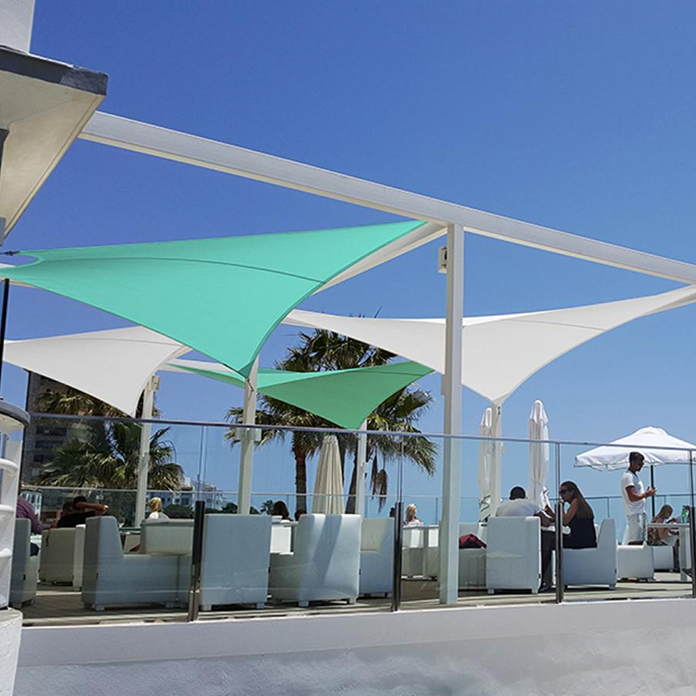
Welcome to the new GALE Commercial | Inspired design. Engineered for life.
  • What fire safety certifications does this fabric have?

    The Commercial NinetyFive 340FR has the most comprehensive FR testing and certifications program, with all colors meeting the most tested regional flame retardancy standards, including CSFM & NFPA 701 (Methods 1 & 2), which ensures our fabrics can be used globally.
  • Is this fabric safe for health and environmental concerns?

    Yes, it's 100% lead and phthalate-free, and it's the first architectural shade cloth in the world to be granted Oeko-Tex® 100 certification. Commercial NinetyFive 340FR It is also endorsed by Cancer Council, Australia's foremost not-for-profit organization for cancer prevention and support.
  • Why choose commercial shade fabric?

    Commercial shade fabric offers UV protection, reduces heat, and creates comfortable outdoor spaces for staff, customers, or visitors. Unlike fixed structures, shade sails and tensioned fabric solutions are flexible, customisable, and visually appealing. They protect people, assets, and enhance the usability of outdoor spaces year-round.
  • Why choose commercial shade fabric over hard surface structures?

    Commercial shade fabric offers style, versatility, and high performance that traditional hard surfaces like metal or timber roofs can’t match. Our engineered fabrics can create permanent structures that provide reliable protection from sun, heat, and UV exposure while keeping spaces inviting and comfortable. With more than 20 color options, you can customize your shade to complement surrounding architecture and landscaping, delivering both functional and aesthetic benefits.
  • Can shade fabrics help reduce energy costs?

    Absolutely. Strategically placed sails can lower heat gain on building exteriors, reducing cooling requirements and contributing to energy efficiency.
  • Are shade fabrics suitable for all types of outdoor areas?

    Yes. Our fabrics perform beautifully in playgrounds, hospitality areas, retail walkways, office courtyards, and industrial sites worldwide.
  • Will the shade fabric installations work year-round?

    Yes. Our fabrics and shade sails are engineered to perform through sun, wind, and rain, providing reliable protection and comfort across seasons.
  • What water resistance can I expect from knitted shade fabric?

    Water permeability of knitted shade fabric is dependent on the shade orientation and force of the rain. It allows water to pass through, helping reduce pooling and maintain airflow.
  • How does the installation angle affect water resistance?

    The installation angle greatly impacts water performance. HDPE polymer used in knitted shade fabric is naturally hydrophobic, so water tends to bead and run along the yarn due to surface tension. If a shade sail is installed horizontal, the water permeability will be 100%. An angled installation under proper tension prevents pooling and improves resistance to moderate rain, providing more reliable protection.
  • What is sustainable advertising banner fabric?

    EcoBanner is the industry's first PVC-free, sustainable advertising banner fabric capable of 100% closed-loop recycling. Winner of the WOO Award for Sustainability, it eliminates the environmental issues associated with traditional PVC billboard materials.
  • Can recyclable tarpaulin perform like traditional billboards?

    Yes. EcoBanner tarpaulin maintains the durability and print quality required for outdoor advertising. Proven on Sydney's Glebe Island Silos during the FIFA Women's World Cup 2023, it's the largest billboard in the Southern Hemisphere, demonstrating that sustainability doesn't mean compromising performance.
  • How does sustainable billboard fabric benefit the advertising industry?

    EcoBanner aligns advertising and sustainability by offering true closed-loop recycling. Traditional PVC banners end up in landfills, but EcoBanner can be repurposed back into manufacturing, helping the out-of-home advertising industry meet global sustainability commitments without retooling operations.
  • What is Aquacon pond liner used for?

    Aquacon is a premium polyethylene dam liner specifically engineered for floating covers and liner applications. The high strength-to-weight ratio and superior buoyancy make it ideal for large-span floating covers on agricultural ponds, wastewater lagoons, and water storage facilities.
  • Can I use Aquacon for water tank liners?

    Yes. Aquacon works perfectly for fabrics, dam liners, and channel liners. It's certified to AS/NZS 4020 and NSF/ANSI/CAN 61 standards for potable water, so you can use it with confidence for drinking water applications and fire protection systems.
  • Why is Aquacon better for prefabrication than other tank liners?

    Aquacon's lightweight construction at 345gsm and excellent lay-flat characteristics make prefabricating tank liners and covers practical. You can fabricate large sections in your shop and transport them to the site without the headaches of handling heavy, bulky materials like traditional PVC alternatives.
  • What makes Aquamark tank liner different from other liners?

    Aquamark 400 is a polypropylene-based tank liner with superior flex-crack resistance that moves with your structure instead of fighting it. The inherently flexible coating doesn't require plasticisers that can leach into water, making it ideal for potable water liner applications.
  • Can Aquamark be used for dam liners?

    Absolutely. Aquamark is specifically engineered for dam liners, pond lining, and water storage applications where water levels constantly change. The 15-year UV warranty and proprietary scuff detection technology catch potential issues before they become expensive problems.
  • Is Aquamark certified for water storage tank liners?

    Yes. Aquamark is certified to AS/NZS 4020 and NSF/ANSI/CAN 61 standards, making it safe for water storage tank liners and potable water applications. The 100% recyclable construction with no chlorine or heavy metals ensures environmental responsibility, too.
  • What water tank liners meet fire protection standards?

    AquamarkPlus is specifically engineered to meet AS2304:2011 requirements for water tank liners in fire protection systems. At 480gsm with 0.65mm thickness, it delivers the enhanced puncture and abrasion resistance demanded by critical fire protection installations.
  • Can AquamarkPlus be used for industrial tank liners?

    Yes. Aquamark +480 works perfectly for industrial tank liners and industrial liquid storage where failure isn't an option. The heavier construction provides superior strength while maintaining the flex-crack resistance and excellent welding characteristics you need.
  • What's the best storage tank liner for fire protection systems?

    AquamarkPlus is designed specifically as a storage tank liner for fire protection systems. It's certified to AS/NZS 4020 and NSF/ANSI/CAN 61 for potable water and meets Section 3.6.1 requirements of AS2304:2011 for fire protection water storage tanks.
  • What is Brattice mining ventilation fabric used for?

    Brattice is a polypropylene industrial tarpaulin designed specifically for underground mine curtains, wall hangings, and ventilation ducting. The permanent anti-static grid and FRAS-certified fire resistance (MDG3608) make it essential for mining safety applications.
  • Does mining ducting cloth need to be fire-resistant?

    Yes. Underground mining operations require ducting cloth that meets strict FRAS certification, including MDG3608 standards for fire resistance, electrical resistance, air permeability, and limited oxygen index. Brattice J175 provides permanent anti-static protection even across sewn joins.
  • What makes Brattice better than other heavy-duty industrial tarps?

    Brattice J175 is lighter weight than typical heavy-duty industrial tarps, making manual handling safer and easier during installation. The smooth surface enhances ventilation performance while the black conductive grid provides permanent anti-static performance that doesn't degrade over time.
  • What is polyethylene tarpaulin used for?

    Polyethylene tarpaulin, like Canvacon, handles everything from shelters and structures to agricultural liners and covers. The woven HDPE scrim reinforcement and advanced coating technology deliver watertight seams with hot air and wedge weldability for diverse applications.
  • What makes Canvacon industrial tarpaulin better than PVC?

    Canvacon industrial tarpaulin is 100% recyclable with no chlorine or heavy metals in production, unlike PVC alternatives. The up to 10-year UV warranty, flex-crack resistance, and temperature resilience across -30°C to +70°C make it more environmentally responsible without sacrificing performance.
  • Can I use woven tarpaulin for agricultural shelters?

    Yes. Canvacon woven tarpaulin works great for agricultural shelters, and dome structures. Available in multiple weights from 240gsm to 410gsm, you can match the exact durability your specific application requires while maintaining easy handling characteristics.
  • What are industrial tarps used for in agriculture?

    Landmark industrial tarps protect bulk grain, hay bales, cotton, and agricultural equipment from harsh weather. At half the weight of PVC tarps, Landmark makes handling quicker and easier while delivering outstanding weather resistance and up to a 7-year UV warranty protection.
  • What's the best fabric for hay bale tarps?

    Landmark is specifically designed for hay bale tarps and has proven its performance across Australia's harshest conditions for over 15 years. The superior lay-flat characteristics, flex-crack resistance, and excellent welding properties make installation straightforward even for large coverage areas.
  • Can I use woven tarpaulin for grain storage?

    Yes. Landmark woven tarpaulin earned its reputation protecting bulk grain across demanding conditions. Available in 340gsm, 360gsm, or 400gsm (tear-stop construction), it provides the exact strength-to-weight ratio your grain storage, bunker covers, or equipment protection requires.
  • What is recycled industrial tarpaulin made from?

    Landmark Recycled 340 contains recycled polypropylene from retired Landmark fabrics, tested to the same strict standards as standard Landmark 340. This industrial tarpaulin offers a true closed-loop recycling solution that eliminates landfill while maintaining field-proven performance.
  • Can recycled hay bale tarps perform like new tarps?

    Yes. Landmark Recycled delivers identical performance to standard Landmark for hay bale tarps, grain covers, and agricultural applications. The same 5-year UV warranty, 340gsm weight, and superior lay-flat characteristics mean you get proven durability in a sustainable package.
  • How much can I save with recycled industrial tarps?

    Compared to sending fabric to landfill, Landmark Recycled's recycling program reduces disposal costs. These industrial tarps re-enter the recycling stream at end-of-life, making environmental responsibility economically practical for agricultural operations.
  • What industrial tarpaulin works for short-term agricultural covers?

    Landmark Edge is specifically engineered for 3-year performance cycles in short-term agricultural applications. This economical industrial tarpaulin solution at 330gsm makes tarp management straightforward with predictable replacement schedules while remaining 100% recyclable at end-of-life.
  • Can I recycle Landmark Edge industrial tarps?

    Yes. Landmark Edge industrial tarps can be recycled through GALE's recycling program to avoid landfill, reducing disposal costs. The PVC-free construction with no chlorine or heavy metals makes recycling practical for agricultural operations looking to balance cost with sustainability.
  • What's the warranty on Landmark Edge industrial covers?

    Landmark Edge comes with a 3-year UV warranty, perfectly matched to its engineered performance cycle for industrial covers, tarps, and ground covers. The lightweight 330gsm construction is strong enough for reliable performance yet easy to handle during fabrication and installation.
  • What is light-reducing fabric for poultry side curtains and piggery shelters?

    Multiblock 425 is the market leader in poultry side curtains and piggery shelters with multi-layered coating and laminated polypropylene construction that creates an effective blackout barrier. The specialised construction controls light exposure where poultry management demands precise environmental conditions.
  • Can I use Multiblock for livestock shade protection?

    Yes. Multiblock works perfectly for shade for livestock, including cattle shade, piggery shelters, and poultry sheds. The 425gsm heavy-duty construction provides long-term durability, while the multi-layer coating delivers a high degree of waterproofing in demanding farm conditions.
  • What makes Multiblock better than other industrial tarpaulins for farms?

    Multiblock's black multifilament scrim with special laminate provides superior light blocking compared to standard industrial tarpaulin. The 5-year UV warranty, flex-crack resistance, and dirt-repellent coating make it ideal for poultry curtains where environmental control directly impacts productivity.
  • What is greenhouse film used for in horticulture?

    Solarweave 185 is a semi-transparent greenhouse film engineered for hothouse applications where balanced light transmission is critical. With over 30 years of proven performance in Australian conditions, it provides optimal light levels for plant growth while protecting from weather extremes.
  • What's the warranty on Solarweave film greenhouse material?

    Solarweave comes with a 5-year UV warranty backed by 30+ years of proven field use. It’s an alternative to film greenhouse material, and it lasts longer, thanks to a UV-stabilised polyethylene scrim reinforcement.
  • What is Commercial NinetyFive shade cloth used for?

    Commercial NinetyFive 340 is a versatile shade fabric perfect for small to medium tension structures and commercial shade sails. It works great for playgrounds, awnings, car park covers, pergolas, and outdoor learning areas where you need reliable sun protection and durability.
  • How much UV protection does architectural shade fabric provide?

    This architectural shade fabric blocks up to 96% of harmful UV rays, and it's the only shade fabric endorsed by Cancer Council Australia. The 15-year UV warranty means you get long-lasting protection that won't fade or break down under harsh sun exposure.
  • Is Commercial NinetyFive flame-retardant shade cloth available?

    Yes, all colours of Commercial NinetyFive meet stringent flame retardant standards, including NFPA 701 and CSFM requirements right out of the gate. This means easier spec approvals and compliance for projects where fire safety matters.
  • How does flame-retardant shade cloth work?

    GALE Commercial’s flame-retardant shade cloth has fire retardants engineered directly into the base yarn rather than applied topically. Commercial NinetyFive 340FR meets NFPA 701 standards across all 22 colours, making it essential for schools, municipalities, and commercial buildings where fire codes apply.
  • What applications require commercial FR shade cloth?

    Many high-traffic public spaces require flame-retardant fabrics by regulations, including schools, hospitals, convention centres, and municipal facilities. Commercial NinetyFive FR works for car park covers, awnings, outdoor learning areas, and any application where fire safety is a priority.
  • What makes Commercial Heavy different from other shade cloth?

    Commercial Heavy 430 is engineered specifically for large span structures and commercial shade structures with its patented intertwining knit pattern. At 430gsm, it's heavyweight construction designed to stay taut and dimensional even in high winds and vast installations.
  • Can Commercial Heavy be used for commercial awnings?

    Absolutely. Commercial Heavy works perfectly for commercial awnings, car park covers, and tension nets where you need superior biaxial strength. The premium round monofilament yarns shed water faster and resist abrasion better than traditional woven fabrics.
  • How does Commercial Heavy perform in high-wind areas for large commercial installations?

    At 430gsm, it delivers the weight and structural integrity needed for commercial shade canopy projects exposed to sustained winds. The heat-set finishing creates exceptional dimensional stability, so your installation maintains tension even during wind events. Fabricators choose Commercial Heavy for coastal areas, elevated structures, and exposed parking lots where wind loads demand more than standard fabrics can deliver.
  • What is the difference between Commercial Heavy and Commercial Heavy FR?

    Commercial Heavy 430FR includes built-in FR fabric technology while maintaining the same 430gsm weight and patented intertwining knit as standard Commercial Heavy. The fire retardants are engineered into the base fibres, so every colour meets NFPA 701 and California State Fire Marshal standards.
  • Can FR Commercial Heavy be used for large commercial shade structures?

    Absolutely. Commercial Heavy FR is specifically designed for large commercial shade structures, car parks, and tension nets where both fire safety and heavy-duty performance are required. The 12-year UV warranty and superior strength make it ideal for demanding installations.
  • What's the best flame-retardant shade cloth for outdoor applications?

    Flame-retardant shade cloth like Commercial Heavy FR delivers the heavyweight performance large-span projects demand with comprehensive fire testing. The 100% round monofilament construction provides improved water-shedding and abrasion resistance compared to flat yarn alternatives.
  • What makes DualShade different from regular shade fabric?

    DualShade 350 features a patented dual-colour knit that creates a stunning iridescent effect when used in architectural shade sails. Two different colored yarns woven into one shade sail fabric transform in sunlight while delivering the same structural integrity you expect from GALE Commercial.
  • Where can I use DualShade for commercial shade structures?

    DualShade is perfect for commercial shade structures like playgrounds, schools, hospitals, sports complexes, and office buildings where you want to make an architectural statement. The 12 distinctive colourways, organised into three collections, give you design flexibility to match any environment.
  • Does DualShade meet fire safety standards for shade fabric?

    Yes, all DualShade colours meet regional flame retardancy standards, including NFPA 701 and CSFM requirements. This makes spec approvals straightforward and ensures your installation meets safety codes right out of the box.
  • Does DualShade come in a flame-retardant version?

    Yes, DualShade 350FR combines the stunning dual-colour iridescent effect with comprehensive FR compliance. All 12 colours meet NFPA 701 standards, making it perfect for high-profile projects like schools and commercial buildings where both aesthetics and fire safety matter.
  • What makes DualShade FR suitable for architectural shade sails?

    DualShade FR brings together architectural shade sails aesthetics with fire safety built in. The patented dual-colour knit creates visual impact while the flame-retardant technology ensures compliance with strict safety standards for premium installations.
  • Can I use FR fabric for commercial shade structures without sacrificing design?

    Yes. DualShade 350FR proves that commercial shade structures don't have to choose between safety and style. The 10-year UV warranty, 12 curated colourways, and fire-retardant compliance make it ideal for projects that demand both visual impact and code compliance.
  • What is greenhouse shade cloth used for?

    Greenhouse shade cloth like Premium Hortshade creates optimal climate control for plant growth in greenhouses, nurseries, and horticultural operations. Available in 30-80% UV block levels, it lets you match precise protection requirements for different crops and growing conditions.
  • How do I choose the right greenhouse shade fabric?

    Greenhouse shade fabric selection depends on your crops and climate. Premium Hortshade offers flexible coverage options from 50% for established crops that need maximum light exposure to 80% UV block for delicate seedlings and heat-sensitive plants. The moisture-resistant HDPE construction won't rot or absorb moisture in humid greenhouse environments.
  • Can agricultural shade cloth be used for livestock?

    Yes. Premium Hortshade works for both horticultural and agricultural shade cloth applications, including cattle shade, livestock protection, and equipment covers. The commercial-grade durability handles demanding farm conditions while the 10-year UV warranty ensures long-term performance.
  • How does G325 compare against other GALE Commercial fabrics for architectural shade projects?

    G325 is a purpose-built shade sail fabric that delivers commercial-grade performance for smaller tensioned installations. At 325gsm with UV-stabilised HDPE construction, this shade cloth provides up to 94% UV block with a 10-year warranty. The heat-set finishing ensures dimensional stability for accurate installations, while the intertwining knit pattern creates the balanced strength needed for commercial shade sails. Available in 10 colours, G325 brings proven GALE Commercial quality to your projects.
  • How do I choose shade fabric for architectural applications?

    When selecting architectural shade fabric, match the fabric weight and construction to your installation size. G325 shade cloth works well for smaller shade sails and tensioned structures with its 325gsm weight and tape & monofilament construction. For larger commercial projects, heavier options like Commercial NinetyFive may be more appropriate. All GALE Commercial shade fabrics are UV-stabilised, heat-set for stability, and backed by extensive testing to ensure reliable performance in real-world conditions.
  • What makes commercial-grade shade cloth different from residential options?

    Commercial-grade shade cloth like G325 is engineered for durability and compliance in public installations. Key differences include UV stabilisers mixed directly into the fabric during manufacturing (not just surface treatments), heat-set finishing for dimensional stability, lead and phthalate-free construction for safety certifications, and compliance with standards like AS 4174:2018. G325 shade sail fabric also comes with a 10-year warranty and provides up to 94% UV block across professional installations from playgrounds to commercial structures.
  • What's the difference between Commercial NinetyFive WP and standard architectural shade fabric for Middle East projects?

    Commercial NinetyFive WP adds a single-side LDPE coating to the proven Commercial NinetyFive base fabric, creating total weather protection without compromising UV stability or strength. While standard architectural shade fabric allows some moisture penetration, the WP version provides a complete waterproof barrier. Both versions block up to 96% of UV rays and meet regional flame retardancy standards, but WP is specifically designed for Middle Eastern climates where rain and intense sun require dual protection.
  • What is waterproof shade cloth used for in the Middle East?

    Commercial NinetyFive WP is perfect for car park covers, pergolas, and playground shading where you need protection from both intense sun, sand and rain.
  • Can Commercial NinetyFive WP handle the same tension loads as regular shade cloth in large installations?

    Yes. Commercial NinetyFive WP maintains the same structural integrity as standard Commercial NinetyFive shade cloth, with the LDPE coating adding weather protection without affecting the fabric's biaxial strength.
  • What is agricultural netting used for?

    Horticultural netting like Quad Crossover protects crops from birds and pests while maximising yield through optimal light balance. The diamond-shaped knit deters even the smallest birds and protects against hail damage while delivering the precise light your crops need.
  • How does crop protection netting help with water conservation?

    Crop protection netting creates a microclimate that reduces transpiration, evaporation, and spray drift. Quad Crossover's four-yarn crossover construction helps conserve water while maintaining optimal moisture levels for plant growth, reducing irrigation costs.
  • What's the difference between Quad Crossover and anti-hail netting?

    Quad Crossover is a multi-purpose anti-hail netting that does more than protect against weather. The diamond lock-stitch provides hail protection while also deterring birds, regulating temperature, and creating better growing conditions through improved air circulation and reduced heat stress.
  • What types of shade fabrics does GALE Commercial provide?

    We offer a range of high-performance fabrics including breathable mesh, water resistant and waterproof (varies by region) solutions. Each fabric is engineered for strength, durability, and long-lasting UV protection. Fabrics are tested for resilience against harsh environments, such as the Australian sun, wind, and rain.
  • How do I choose the right fabric for my project?

    Consider what’s most important: sun protection, airflow, waterproofing, aesthetics, or brand colours. Our team and authorised fabricators are available to guide you through the options to ensure the perfect fit for your site and needs.
  • What’s the difference between knit fabric and woven fabric? What are the pros and cons of both?

    Both knit and woven fabrics are made from yarns, but they differ in how the yarns are arranged. Knit fabrics are formed from interlocking loops of yarn, giving them natural stretch, flexibility, and ease of shaping. This interlocking structure allows knitted shadecloth to handle long spans while moving with tensioned installations. Woven fabrics interlace yarns at right angles, creating a tighter surface with smaller gaps. They are more water-resistant and are typically used in applications like awnings and umbrellas, where shorter spans and heavier structural support are required.

    Knits excel in flexibility, tensioned performance, and the ability to cover large areas with minimal support. Wovens work best when dimensional stability and water resistance are priorities, but they rely on more rigid framing for support.
  • When would I use Commercial NinetyFive versus Commercial Heavy?

    Commercial NinetyFive is ideal for standard commercial structures with posts up to 40 feet or 12 metres apart. The fabric provides the most ideal balance of UV protection, airflow, and strength.

    Commercial Heavy is suited for larger structures with posts up to 80 feet or 24 metres apart. This fabric is ideal for more demanding conditions, such as large spans, high winds, or exposure to heavy rain and debris.

    The choice depends on installation size, load expectations, and longevity requirements.
  • Is DualShade a superior fabric because the 350 number is greater than Comm NinetyFive’s 340 number?

    Not necessarily. Fabric weight numbers indicate one aspect of performance, but overall performance depends on several factors including weight, stretch, UV stability, and biaxial stability.
  • Which Commercial fabrics are good for hail protection?

    For hail-prone areas, fabrics with higher tensile strength, heavier weight, and tight weave structures are recommended. Commercial Heavy and DualShade offer enhanced resistance to impact, reducing the risk of damage and prolonging the lifespan of outdoor structures.
  • What UV protection levels are available?

    All our fabrics meet or exceed international standards for UV protection, with UV block up to 96.5%, keeping people safe while maintaining long-term fabric integrity.
  • Can sails be customised in shape and size?

    Absolutely. Triangular, rectangular, and multi-sail configurations can be tailored to cover any space, large or small.
  • What design considerations should I keep in mind?

    Think about coverage area, wind load, support placement, slope for water runoff, and integration with existing structures. Our shade partners optimise both functionality and visual impact.
  • Can shade sails combine water-resistant and breathable fabrics?

    Yes. Hybrid solutions allow airflow while providing rain protection where required, ideal for versatile outdoor spaces. NOTE: Waterproof fabrics only available in select regions, whereas water-resistant fabrics are available in all regions.
  • How does fabric tensioning affect performance?

    Correct tension keeps sails taut, maintains shape, prevents sagging, and ensures long-term durability, even in challenging weather conditions.
  • Can multiple sails be combined for larger coverage?

    Absolutely. Multi-sail configurations create expansive coverage, beautiful designs, and excellent airflow.
  • Does GALE Commercial provide installation services?

    We partner with fabricators and installers around the globe that handle full installation, ensuring hardware and structural supports meet the highest standards for safety and performance. To find a local partner near you, click here.
  • What are stretch factors and how do they affect how a fabric hangs and weathers the elements?

    Stretch factors describe how much a fabric can elongate under tension. Fabrics with controlled stretch, such as our Commercial fabrics, allow for smooth installation without sagging and maintain tension under wind or rain. Excessive stretch can cause uneven tension, while too little can lead to cracking or tearing in extreme weather. Understanding stretch helps ensure a shade sail or tensile structure remains taut, durable, and visually appealing over its lifetime.
  • What is biaxial stability and why does it matter?

    Biaxial stability refers to a fabric’s ability to resist stretching in both warp and weft directions. For commercial structures, this ensures the fabric holds its shape under load, maintains consistent tension across the installation, and prevents distortion over time. High biaxial stability reduces maintenance and extends the lifespan of outdoor installations exposed to sun, wind, and rain.
  • Can sails be installed on existing structures?

    Yes. Sails can attach to walls, posts, or purpose-built structures, depending on your site. We assess your environment and recommend the best approach.
  • What types of hardware are used for installation?

    We use industrial-grade fittings, wire ropes, tensioners, and supports engineered for strength, safety, and durability in any climate.
  • Is professional installation necessary?

    Professional installation is strongly recommended. It ensures safety, optimal performance, and protects warranties.
  • How do fabric mechanical properties affect the actual shade sail structure after it’s installed?

    Mechanical properties, like tensile strength, stretch factor, and biaxial stability, determine how a fabric performs under load, wind, and sun exposure. Fabrics with optimal mechanical properties can maintain even tension, reduce sagging, and resist tearing, ensuring the structure remains visually appealing, safe, and durable over time.
  • How long will shade sails last?

    With proper care, installation, and fabric selection, our sails are built to last many years across diverse environments.
  • What maintenance is required?

    Check fittings and tension regularly, clean fabrics to remove debris, and inspect after extreme weather. Minimal effort keeps sails performing at their best.
  • Can sails withstand strong winds or storms?

    Yes. Fabrics and hardware are engineered to resist typical commercial wind loads. For extreme conditions, temporary removal or additional securing may be recommended.
  • How should shade fabrics be cleaned?

    Gentle washing with water and mild detergent is recommended. Avoid harsh chemicals and cleaners with bleach or chlorine, as they could compromise the fabric.
  • What happens when a sail reaches the end of its life?

    Old sails can be replaced with new custom solutions. GALE Commercial can also advise on responsible disposal or recycling options, keeping sustainability in mind.
  • What thread should be used to fabricate shade sails?

    When fabricating knitted shade cloth, ensure all materials (fabric, thread, webbing) are UV-resistant, as UV radiation is the primary cause of degradation for outdoor shade products. We recommend the use of UV-resistant PTFE or heavy-duty coated polyester thread to help ensure that the stitching lasts as long as the shade fabric.
 
Stay Up To Date

Subscribe to GALE Commercial

By clicking 'Submit,' you consent to receive email messages from GALE Commercial.
For more information, see our privacy policy.